





Bitte beachten Sie, dass diese Inhalte mithilfe von KI übersetzt wurden. Trotz sorgfältiger Prüfung können automatische Übersetzungen kleinere Ungenauigkeiten enthalten, wie ungewohnte Fachbegriffe oder sprachlich nicht ganz flüssige Formulierungen. Vielen Dank für Ihr Verständnis.
Tenga en cuenta que estos contenidos han sido traducidos mediante inteligencia artificial. Aunque procuramos garantizar la mayor precisión posible, las traducciones automáticas pueden contener pequeñas imperfecciones, como el uso de términos poco habituales o frases que no suenen completamente naturales. Agradecemos su comprensión.
Inside sales, support and helpdesk teams work in separate channels. What that costs, and how an omnichannel contact center fixes it.
Your support desk has a shared mailbox.
A phone number.
A chat widget on the website.
And a ticketing system nobody outside the team ever opens.
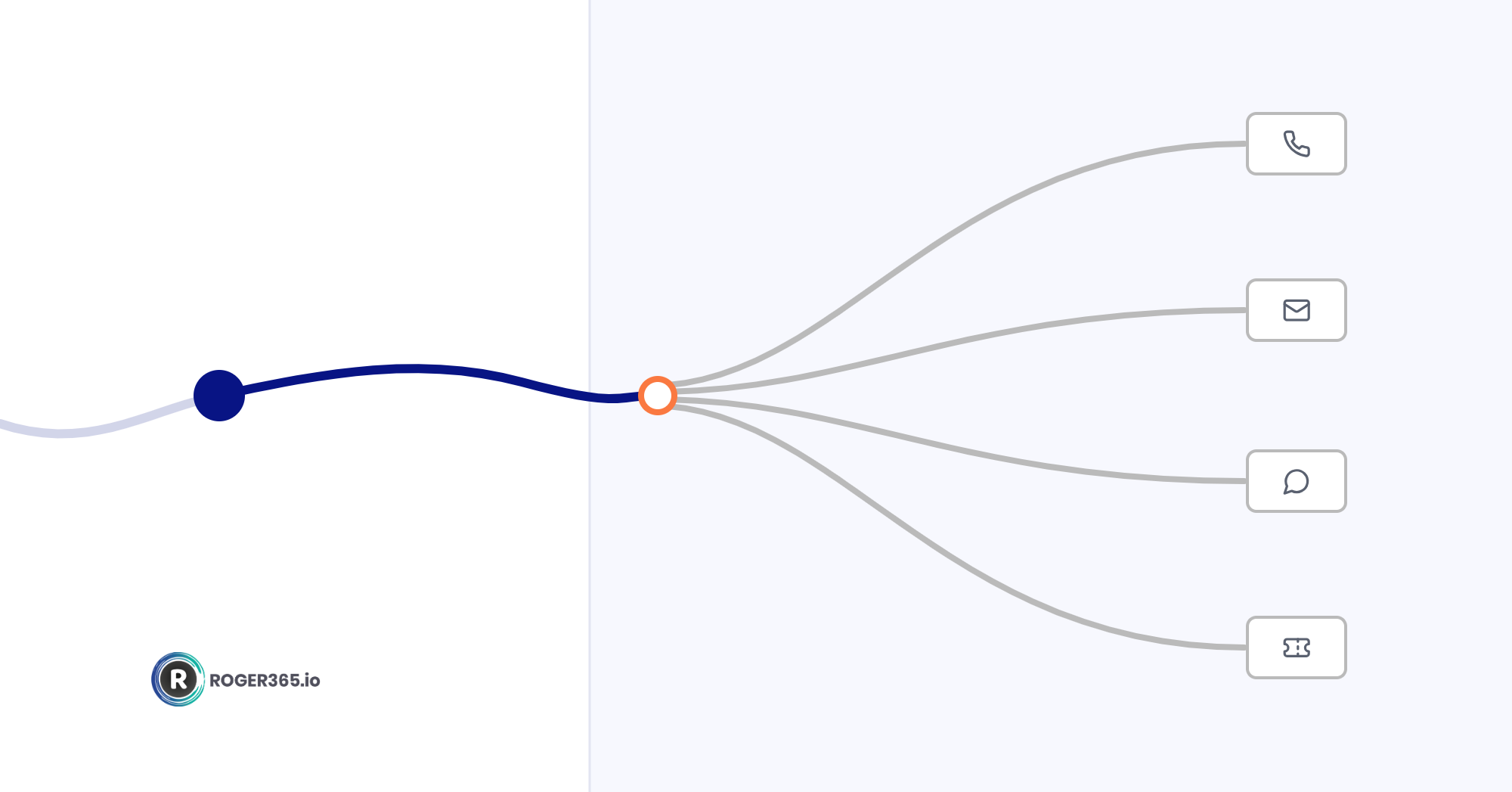
Four channels. Four queues. One customer, who assumes you are one company.
The work arrives, but nobody sees the whole
Ask any head of support how much work came in this morning and you get an estimate. Not because the team is sloppy, but because the answer sits in four systems that do not talk to each other.
Telephony knows how many calls came in, but not what they were about. The mailbox knows how many messages are waiting, but not who is already working on them. Chat knows how many conversations ran, but not which ones were resolved. The ticketing system knows what was logged, and therefore by definition not what was never logged.
Inside sales has the same problem in a different shape. The quote request arrives through the web form, the question about it comes in by phone to someone else, and the follow-up happens from a personal mailbox the rest of the team cannot see.
Add up what that costs in practice:
- Work done twice. Two colleagues pick up the same ticket, or nobody picks it up because everyone assumes it sits with someone else.
- No view of the workload. You cannot steer what you cannot see, so staffing gets set by instinct rather than by volume.
- SLAs you cannot evidence. When a customer asks how fast you responded last month, the answer is a reconstruction.
- The customer who starts over. A conversation that began in chat and escalates to a call begins at zero. Exactly when it became urgent.
That last one is the expensive one. Among B2B buyers considering a switch, fifty-one per cent name not being connected to the right person who could help. The same fifty-one per cent name the absence of customer tracking across channels as an impediment to doing business. Those are not service metrics. Those are commercial metrics.
Both figures come from McKinsey's B2B Pulse Survey, which questioned nearly four thousand B2B decision makers across thirteen countries. Its 2026 edition confirms the same causes still rank as the leading reasons to change supplier.
You don't need another channel
This is where the thinking goes wrong. When pressure rises, a channel gets added. A chatbot to relieve the mailbox. A second number for technical questions. A form for quote requests so they stop disappearing into the rest.
Each of those fixes one symptom and grows the underlying problem, because it adds another queue that does not know the others exist.
This is not a telephony problem and it is not an email problem. It is a distribution problem. Work arrives through several entrances, and there is no layer that brings it together, prioritises it and assigns it to whoever can resolve it.
That is exactly what an omnichannel contact center does. Not offering more channels, but bringing every channel into one stream of work.
What changes with one queue for all of it
All incoming work lands in the same stream. Voice, email, chat and messaging arrive in ROGER365.io Contact Center as a single workload. With Intelligent Call Queues and skill-based or priority routing, each contact goes to whoever can answer it rather than whoever happens to be free. A conversation that started in chat and continues by phone keeps its history.
Your people see the customer and the case before they start. A connection to your CRM or ticketing system shows the agent who is getting in touch, which cases are open and what the last contact was. That removes the opening question of who you are speaking to, and it removes the after-call work, because logging happens in the same place.
You can see the operation while it runs. Wallboards show the live workload, wrap-up codes make it visible where volume comes from, and reporting per customer or per queue turns an SLA into a number instead of a promise. Supervisors steer during the peak rather than after it.
All of it inside Microsoft Teams, where your people already work. No second desktop, no separate admin platform. And because ROGER365.io bills per queue rather than per user, colleagues outside the team can step in during busy periods without the licence cost following them.
No one gets left on hold.
That is the promise. And it holds even if your traffic is currently spread across four systems.
Take AXI Digital, an ICT services firm of roughly three hundred people across Belgium and the Netherlands. Their service desk ran telephony on one platform and chat on another. On forwarded calls the caller's number was hidden, so agents often could not see who had tried to reach them. Calling back was guesswork, and every conversation opened with working out who was on the line and what it was about.
Today all of that traffic arrives in six queues in ROGER365.io Contact Center across three locations, with a connection to TOPdesk. On every call the agent sees the caller, the open tickets and the case history before picking up. Context and intent are clear straight away, so the opening question has gone and the conversation starts with the substance. And because everything arrives in one stream, there is now reporting per client on response time, accessibility and call duration: SLA follow-up has become a number rather than a reconstruction.
“ROGER365.io helps AXI Digital run one reliable service desk across Belgium and the Netherlands, with zero dropped calls and every location able to answer every call.” – Steven Goeman, Service Operations Manager, AXI Digital
On 26 November we go deeper into this in a webinar, built around the seven problems we keep seeing in the Flemish market, with the numbers alongside them.
Register for the webinar on 26 November


Industry
Location
Bitte beachten Sie, dass diese Inhalte mithilfe von KI übersetzt wurden. Trotz sorgfältiger Prüfung können automatische Übersetzungen kleinere Ungenauigkeiten enthalten, wie ungewohnte Fachbegriffe oder sprachlich nicht ganz flüssige Formulierungen. Vielen Dank für Ihr Verständnis.
Tenga en cuenta que estos contenidos han sido traducidos mediante inteligencia artificial. Aunque procuramos garantizar la mayor precisión posible, las traducciones automáticas pueden contener pequeñas imperfecciones, como el uso de términos poco habituales o frases que no suenen completamente naturales. Agradecemos su comprensión.
Inside sales, support and helpdesk teams work in separate channels. What that costs, and how an omnichannel contact center fixes it.
Your support desk has a shared mailbox.
A phone number.
A chat widget on the website.
And a ticketing system nobody outside the team ever opens.
Four channels. Four queues. One customer, who assumes you are one company.
The work arrives, but nobody sees the whole
Ask any head of support how much work came in this morning and you get an estimate. Not because the team is sloppy, but because the answer sits in four systems that do not talk to each other.
Telephony knows how many calls came in, but not what they were about. The mailbox knows how many messages are waiting, but not who is already working on them. Chat knows how many conversations ran, but not which ones were resolved. The ticketing system knows what was logged, and therefore by definition not what was never logged.
Inside sales has the same problem in a different shape. The quote request arrives through the web form, the question about it comes in by phone to someone else, and the follow-up happens from a personal mailbox the rest of the team cannot see.
Add up what that costs in practice:
- Work done twice. Two colleagues pick up the same ticket, or nobody picks it up because everyone assumes it sits with someone else.
- No view of the workload. You cannot steer what you cannot see, so staffing gets set by instinct rather than by volume.
- SLAs you cannot evidence. When a customer asks how fast you responded last month, the answer is a reconstruction.
- The customer who starts over. A conversation that began in chat and escalates to a call begins at zero. Exactly when it became urgent.
That last one is the expensive one. Among B2B buyers considering a switch, fifty-one per cent name not being connected to the right person who could help. The same fifty-one per cent name the absence of customer tracking across channels as an impediment to doing business. Those are not service metrics. Those are commercial metrics.
Both figures come from McKinsey's B2B Pulse Survey, which questioned nearly four thousand B2B decision makers across thirteen countries. Its 2026 edition confirms the same causes still rank as the leading reasons to change supplier.
You don't need another channel
This is where the thinking goes wrong. When pressure rises, a channel gets added. A chatbot to relieve the mailbox. A second number for technical questions. A form for quote requests so they stop disappearing into the rest.
Each of those fixes one symptom and grows the underlying problem, because it adds another queue that does not know the others exist.
This is not a telephony problem and it is not an email problem. It is a distribution problem. Work arrives through several entrances, and there is no layer that brings it together, prioritises it and assigns it to whoever can resolve it.
That is exactly what an omnichannel contact center does. Not offering more channels, but bringing every channel into one stream of work.
What changes with one queue for all of it
All incoming work lands in the same stream. Voice, email, chat and messaging arrive in ROGER365.io Contact Center as a single workload. With Intelligent Call Queues and skill-based or priority routing, each contact goes to whoever can answer it rather than whoever happens to be free. A conversation that started in chat and continues by phone keeps its history.
Your people see the customer and the case before they start. A connection to your CRM or ticketing system shows the agent who is getting in touch, which cases are open and what the last contact was. That removes the opening question of who you are speaking to, and it removes the after-call work, because logging happens in the same place.
You can see the operation while it runs. Wallboards show the live workload, wrap-up codes make it visible where volume comes from, and reporting per customer or per queue turns an SLA into a number instead of a promise. Supervisors steer during the peak rather than after it.
All of it inside Microsoft Teams, where your people already work. No second desktop, no separate admin platform. And because ROGER365.io bills per queue rather than per user, colleagues outside the team can step in during busy periods without the licence cost following them.
No one gets left on hold.
That is the promise. And it holds even if your traffic is currently spread across four systems.
Take AXI Digital, an ICT services firm of roughly three hundred people across Belgium and the Netherlands. Their service desk ran telephony on one platform and chat on another. On forwarded calls the caller's number was hidden, so agents often could not see who had tried to reach them. Calling back was guesswork, and every conversation opened with working out who was on the line and what it was about.
Today all of that traffic arrives in six queues in ROGER365.io Contact Center across three locations, with a connection to TOPdesk. On every call the agent sees the caller, the open tickets and the case history before picking up. Context and intent are clear straight away, so the opening question has gone and the conversation starts with the substance. And because everything arrives in one stream, there is now reporting per client on response time, accessibility and call duration: SLA follow-up has become a number rather than a reconstruction.
“ROGER365.io helps AXI Digital run one reliable service desk across Belgium and the Netherlands, with zero dropped calls and every location able to answer every call.” – Steven Goeman, Service Operations Manager, AXI Digital
On 26 November we go deeper into this in a webinar, built around the seven problems we keep seeing in the Flemish market, with the numbers alongside them.
Register for the webinar on 26 November
Follow them
Location

Our speakers
Need advice?
Ask Fabien our feature expert
Schedule a call with Fabien to get started!

Want to read more?
Discover fresh perspectives and practical tips in our latest whitepaper.